


An Anchored Entrance

Your driveway is the preamble to your home. Before you even reach the front door, the entrance sets the tone for how a whole property feels once you’re in it. Recently, we encountered a driveway edge that was ready to graduate into more appropriate landscaping for both the home and the neighborhood. It was an unfinished, overgrown property line bordered by a deteriorating rubble wall. The homeowners wanted more privacy from their neighbors and a clearer boundary for the property edge. What we saw was an opportunity to bring the existing landscape into better balance and beauty.

In landscape design, I often find myself studying the places where things meet. Where stone meets soil, where an old wall ends and a new one begins, where the limbs of mature trees reach across an open space. These transitions can become some of the most interesting parts of a design. For this Austin property, the idea was to take this unrefined boundary and give it structure, privacy, and natural beauty while respecting the character of the home and its surroundings.
We began by hauling away the crumbling rock and debris to make way for the foundation of a new 98-foot limestone retaining wall. The challenge was connecting the new construction to an existing Craftsman-style limestone wall.


Natural stone has a character of its own, with variations in color, shape, texture, and size. It takes a skilled mason with an experienced eye to understand how those individual pieces fit together. Our team carefully matched the original masonry so the new wall would look to have been part of the property all along.
Starting flush with the road, the wall steps down gracefully as it follows the grade, outfitted with discreet weep holes to manage drainage naturally. It immediately established a confident, defining edge. The gentle change in elevation gives the wall a pleasing pace along the driveway, and the drainage details allow water to escape from behind the structure. Good craftsmanship should be appreciated both for what we see and for how well it holds up over time.


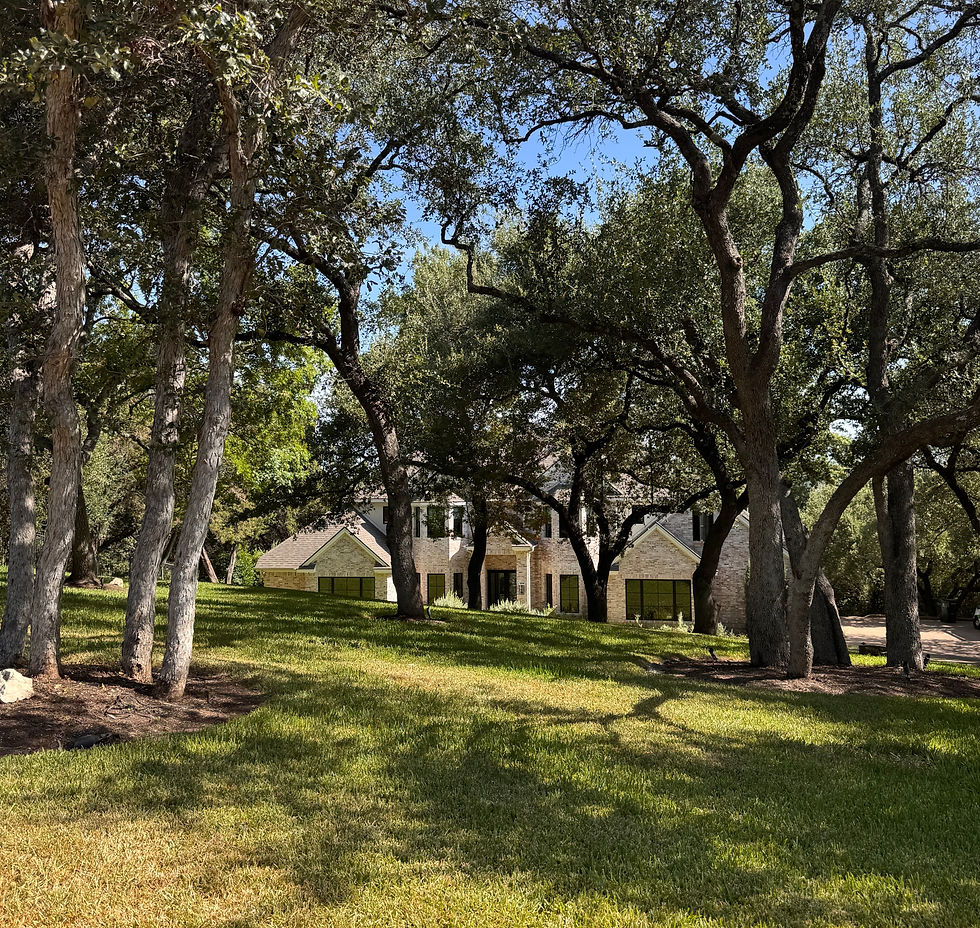
With the stonework in place, we turned our attention to the living elements of the design. The property already had beautiful mature trees that contributed shade, character, and a sense of place. We selected a fiercely resilient palette of native and adapted plants, weaving them carefully between the property’s existing mature trees and Texas Mountain Laurels, which we preserved as the backbone of the composition.

Privacy was another important part of the planting plan. A backdrop of Cherry Laurel and Yaupon Holly establishes neighborly but effective privacy. In front of these evergreens, Twistleaf Yucca and Green Cloud Texas Sage introduce strong architectural forms and interesting contrasts in foliage. Closer to the driveway, we brought in softer, more naturalistic plantings, including Turk's Cap, Cedar Sage, White Mistflower, Inland Sea Oats, and Holly Fern. These three layers work together to create depth, seasonal interest, and a gradual transition between the stone wall and the garden.

Of course, designing with plants in Central Texas requires a strong consideration of our climate. Between the scorching summers, unpredictable rainfall, and occasional hard freezes, choosing the right plant for the right place can make all the difference. We considered the existing shade, soil conditions, mature plant sizes, and water needs of each species. Even drought-tolerant plants need regular attention while their roots become established. With thoughtful placement and proper care, the garden can grow into its new surroundings and become more beautiful with each passing season.

The result is a driveway scape that feels entirely transformed yet perfectly established, as if it has always belonged there. By pairing custom, craftsman masonry with a deeply considered, drought-tolerant plant palette, we've created an entrance that is an ode to its Central Texas surroundings. The stone gives the property definition, while the plantings bring softness, privacy, and life to an area that once felt unfinished.
There is something just so satisfying about finding the potential in an awkward, unfinished space. A deteriorating wall, a failing boundary, or a change in elevation can lead us toward a design we might never have considered otherwise. And sometimes, the best built additions to a classic Hill Country home are ones that belong so well they look like they’ve always been there.
Comments